The Strategic Transformation of Professional Services Recruitment: A Multi-Sector Analysis of Legal and Insurance Talent Acquisition
A multi-sector analysis of the shift in legal and insurance recruitment from traditional models (OCI, job boards) to direct recruiting, niche digital communities, and the 'Talent on Tap' modular hiring paradigm. The report examines sourcing strategies, unit economics, technology stacks, and structural challenges like bias and retention.
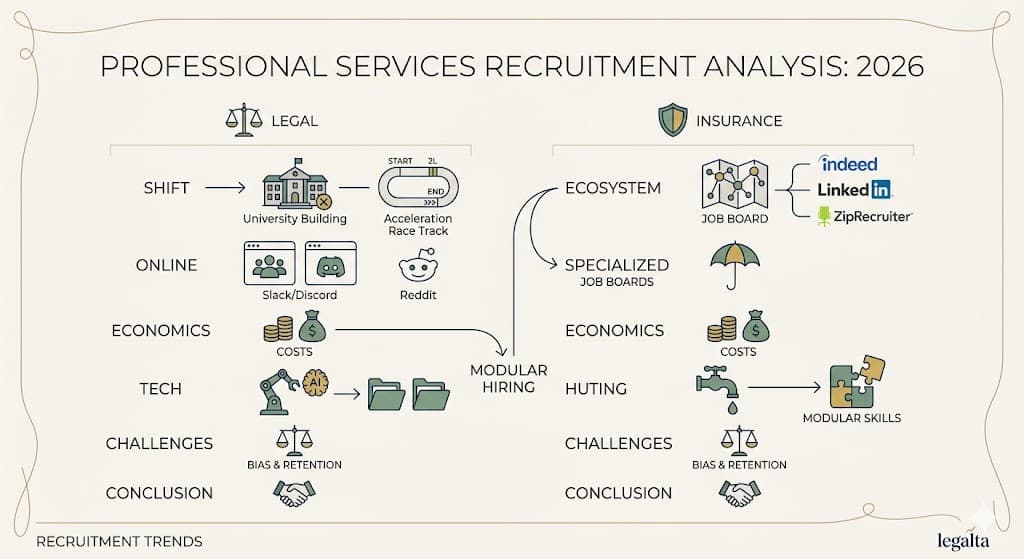
The Strategic Transformation of Professional Services Recruitment: A Multi-Sector Analysis of Legal and Insurance Talent Acquisition
The contemporary landscape of professional services recruitment, particularly within the legal and insurance sectors, is undergoing a profound structural realignment. This shift is characterized by the obsolescence of traditional, institutionally-sanctioned pipelines and the emergence of hyper-accelerated, technology-driven sourcing mechanisms. For decades, the legal industry relied upon the predictable cadence of on-campus interviewing (OCI), while the insurance sector operated through high-volume job boards and established brokerage networks. However, evidence from the 2024-2025 recruiting cycles indicates that these legacy models have been superseded by direct recruiting, niche digital communities, and the "Talent on Tap" modular hiring paradigm. The following report provides an exhaustive analysis of these dynamics, exploring school-based pipelines, niche sourcing, unit economics, and the sophisticated technology stacks currently defining the field.
The Paradigm Shift in Legal Sourcing: The De-Institutionalization of Entry-Level Pipelines
The most significant development in legal recruiting is the rapid marginalization of On-Campus Interviewing (OCI). Historically, OCI served as the reliable backbone of legal recruitment, providing a structured window where law schools dictated the schedule and firms followed suit.1 This model has effectively collapsed. According to recent National Association for Law Placement (NALP) data, for the first time in history, law firms are no longer primarily utilizing OCI to recruit the next generation of associates.2 Instead, the market has gravitated toward direct recruiting and other non-law school-based practices as the primary means of securing talent.2
The Acceleration of the Recruiting Timeline
The velocity of the legal hiring cycle has accelerated to a degree that fundamentally disrupts the traditional law school experience. Recruitment, which traditionally took place in the fall of a student’s second year (2L), has moved aggressively into the summer and even the spring of the first year (1L).2 Firms are now racing to make "first contact" with sought-after candidates, leading to a "free-market" environment that operates outside the oversight of law school career services offices.2 This shift is quantified by the timing of summer associate offers; in 2024, July was the most popular offer month, accounting for 45% of all offers, followed by June at 30%.3 Only 20% of offers were extended in August, which was historically the peak month for OCI.3
| Offer Timing Comparison | 2023 Offer Volume | 2024 Offer Volume | Trend |
|---|---|---|---|
| June or Earlier | Negligible | 30% | Aggressive Acceleration |
| July | 45% | 45% | Consolidation |
| August | 52% | 20% | Sharp Decline |
| Offers Prior to August | 45% | 78% | Strategic Shift |
Source: 2
This acceleration has created a "bidding war" for 1L talent. Some firms have begun extending 1L and 2L offers simultaneously as a policy, effectively locking up talent for two years before students have completed their first year of legal education.4 The implications for students are severe; the focus has shifted almost entirely to prestigious law schools as a proxy for potential, as firms are increasingly making hiring decisions before 1L grades or journal memberships—traditional signals of merit—are even finalized.4
The Regional Dominance of Elite Law Schools
The prestige of a law school remains the primary filter in this accelerated environment. Elite schools continue to place a significant majority of their graduates into "BigLaw" roles (firms with 100+ attorneys). Schools in major legal markets, particularly Chicago, New York, and Washington D.C., show stronger placement rates regardless of national rankings.5
| Law School | BigLaw Placement Rate (2024-2025) | Federal Clerkship Rate | Total Prestige Outcome |
|---|---|---|---|
| Columbia University | 73.0% | 5.5% | 75.55% |
| Northwestern University | 62.1% | 5.5% | 67.80% |
| University of Chicago | 61.1% | 10.5% | 61.11% |
| University of Virginia | 60.2% | 12.0% | 65.26% |
| Duke University | 77.3% | 10.5% | 87.80% |
| Loyola University Chicago | 24.3% | 0.9% | 25.20% |
Sources: 5
In the Chicago market, a unique confluence of factors—including the presence of large health systems and dominant commercial payers—shapes the demand for specific legal specialties.9 While elite schools like the University of Chicago and Northwestern feed the global BigLaw firms, regional schools like Loyola University Chicago and Chicago-Kent College of Law provide critical talent for mid-sized firms and specialized practices.7 However, the shift toward early hiring has made it increasingly difficult for "late-blooming" students at middle-of-the-pack schools to break into the elite firm stream, as firms focus their limited resources on the top-tier institutions early in the cycle.4
Niche Online Communities: The New Sourcing Ground
As traditional job boards become saturated and OCI fades, legal recruiters are turning toward niche online communities to identify and engage with specialized talent. These platforms serve as digital "water coolers" where practitioners discuss firm culture, salary benchmarks, and practice-specific challenges, providing recruiters with access to passive candidates who are not actively searching on LinkedIn or Indeed.10
Private Slack and Discord Networks
The rise of Slack and Discord as professional networking tools has created fragmented but highly valuable talent pools. These communities are often niche-specific, focusing on particular industries or skill sets.12
- LawyerSmack: This is arguably the leading private Slack community for lawyers, offering over 100 channels ranging from state-specific discussions to practice-area deep dives.10 For an annual fee of $199, members gain access to a curated network of peers, allowing for real-time knowledge exchange and "off-the-record" firm reviews.11
- The Law Community (TLC): Launched by Clio, this network is designed for legal professionals to share tech skills and best practices. While currently restricted to Clio customers, it represents a trend toward vendor-led community building that fosters a sense of "tech-forward" identity among practitioners.11
- Recruiting Brainfood and HRtoHR: In the broader talent acquisition space, Slack communities like Recruiting Brainfood offer recruiters a space for "real-talk" on market trends and sourcing techniques.12 These groups allow recruiters to share "silver medalist" candidates—those who were highly qualified but not hired for a specific role—effectively creating a decentralized talent pool.14
Reddit and Anonymous Forums
Reddit has emerged as a critical platform for candid industry insights. The subreddit r/LawFirm (105,000+ members) and r/Lawyertalk are used by practitioners to discuss the operational realities of running a firm and to seek career advice.10 The anonymity of these platforms allows for a level of transparency regarding "exploding offers," billable hour pressures, and firm toxicity that is absent from branded platforms like LinkedIn.1 Recruiters who "lurk" in these communities can gain a nuanced understanding of candidate pain points, allowing them to tailor their outreach strategies to address specific cultural or financial desires.16
The Insurance Recruitment Ecosystem: Platforms and Sourcing Strategies
Recruiting in the insurance industry faces a distinct set of challenges, primarily driven by an aging workforce and a persistent "branding" problem. Research indicates that 61% of professionals believe the insurance industry suffers from an outdated image, which makes it difficult to attract young, diverse talent.17 Consequently, insurance carriers and agencies must utilize a more diverse array of platforms to reach both active and passive candidates.
The Role of Generalist Platforms: Indeed, LinkedIn, and ZipRecruiter
Generalist platforms remain the primary source for high-volume hiring in insurance, though they serve different strategic purposes.
- Indeed: The "search volume" leader. Indeed is most effective for early-stage job searches and high-volume roles such as claims adjusters or customer service representatives.18 It offers strong filtering by salary transparency and remote/hybrid options, which are critical differentiators in the current market.18 However, high spend on Indeed can lead to the "Quantity Over Quality Trap," where recruiters are overwhelmed by irrelevant applications.19
- LinkedIn: The "most complete ecosystem." LinkedIn is preferred for technical roles (actuaries, underwriters) and leadership positions.18 It allows for direct messaging with passive candidates, a vital strategy since the best talent in insurance is often not actively searching for work.18 However, the cost of LinkedIn Recruiter licenses (approx. $8,000 annually per seat) can be "brutal" for smaller agencies.21
- ZipRecruiter: Known for its AI matching and broad distribution. ZipRecruiter is often used to "smooth out the early funnel," using AI to match candidates and allow recruiters to rate and filter them from a single dashboard.22
Specialized Insurance Job Boards
For technical and mid-career moves, specialized boards provide "higher quality and lower noise" than generalist platforms.18
| Platform | Target Audience | Primary Role Focus |
|---|---|---|
| Insurance Journal | Experienced Professionals | Risk Management, Underwriting, Claims 23 |
| iHireInsurance | Credentialed Talent | Actuaries, Compliance, Legal 24 |
| ARIA Job Board | Research & Risk | High-level Risk Management specialists 23 |
| Redbird Job Board | Sales Professionals | Insurance Sales and Distribution 18 |
| Central Insurance School | Entry-level / Students | Recent graduates with fresh training 23 |
The most successful insurance hiring strategies now prioritize attracting smaller pools of highly relevant candidates rather than casting the broadest possible net.19 This is particularly important for "hybrid" roles that require both insurance fundamentals and new-school digital innovation skills.20
The "Talent on Tap" and Modular Hiring Paradigm
A revolutionary shift is occurring in the way professional services firms view headcount. The "Talent on Tap" model anticipates a world where almost any service—from skilled consulting to legal triage—can be obtained on a pay-per-use basis.25 This model goes beyond traditional gig platforms, using agentic AI to handle the logistics of finding, scheduling, and paying providers with specific, niche skills.25
Mechanisms and Application in Insurance and Law
In the insurance industry, the "Talent on Tap" model is used to address fluctuating headcounts and the need for rare technical expertise.26
- Modular Skill Sets: Firms are moving away from rigid job descriptions toward flexible, skill-based engagements.28 This is particularly evident in firmware and embedded engineering for "Insurtech" projects, where niche engineers are deployed at pace for specific project outcomes rather than long-term roles.29
- Fractional Recruiting: Agencies like "Talent on Tap" operate as strategic partners, matching top talent with businesses to drive efficiency without the overhead of a permanent HR staff.30
- AI-Driven SmartMatching: Platforms like Employment Hero scan a pool of over 1 million jobseekers to build live shortlists of curated talent before a firm even knows it needs to hire.31 This "SmartMatch" technology is reported to save 30-45 minutes per candidate during the screening phase.32
In the legal sector, this model manifests as the "Supertemp" or interim leadership roles.33 Firms use "Talent on Tap" to manage peak workloads—such as large-scale discovery or M&A due diligence—without the permanent salary commitments and "fallout" associated with in-house terminations.34 Agentic AI advisors can now guide human advisors or even function as autonomous team members, providing industry-focused advisory services at a fraction of the cost of human staff.25
Unit Economics of Professional Sourcing: The $65,000 Hire
The financial implications of a professional hire are staggering. One mid-sized law firm recently reported paying $65,000 in agency fees alone to hire a single lawyer.35 This "level of spending" has become accepted as the norm, yet it drains budgets and forces firms to offer inflated starting salaries—often 10–20% above market rate—to remain competitive.35
The Breakdown of Recruitment Costs
The total cost of hiring (Cost-Per-Hire or CPH) includes both "hard" external costs and "soft" internal costs. For professional services, the CPH is significantly higher than the national average.36
| Metric | Non-Executive Average | Legal/Prof Services | Executive / Partner |
|---|---|---|---|
| Cost-Per-Hire (CPH) | $5,475 | $16,000 - $20,000 | $35,879 - $100,000+ |
| Agency Fee (% of Salary) | 15% - 25% | 20% - 30% | 25% - 35% |
| Vacancy Cost (per day) | $500 | $1,000+ | $2,500+ |
| Bad Hire Cost (% of Salary) | 30% | 50% - 150% | 200%+ |
Sources: 35
Sourcing Fees: Contingency vs. Retained
Recruitment agencies typically operate on one of two fee structures:
- Contingency-Based: The firm pays only if the candidate is hired. This is standard for associate-level and mid-level insurance roles. Fees are usually 20-25% of the first-year base salary.37 While low-risk, this model can lead to "competitive pressure" for agencies to send a high volume of candidates rather than a curated list.39
- Retained Search: The recruiter is engaged exclusively and paid in installments (usually thirds). This is the standard for partner-level hires and C-suite executives in insurance.37 Fees range from 25% to 35% of total first-year compensation, including guaranteed bonuses.38
The Cost of Vacancy and Billable Hours
In a law firm, the revenue system is based on billable hours. A vacancy doesn't just represent a lack of staff; it represents a direct loss of revenue. With a median time-to-fill of 44 days, a firm can lose over $22,000 in potential billing before a recruiter is even paid.36 This economic pressure drives firms to accept the high placement fees of specialist recruiters who can "find talent quickly".20
Ideal Candidate Profiles and Required Credentials
The "ideal candidate" in legal and insurance sectors is no longer defined solely by tenure. Firms are looking for a combination of technical mastery (credentials) and behavioral competencies (EQ, adaptability).
Legal Credentials and Behavioral Traits
While law firms still fixate on law school prestige and GPA, they are increasingly valuing "client-readiness" and emotional intelligence.40
- Core Credentials: JD from an ABA-accredited school, Bar admission, Law Review/Moot Court (though these are declining in importance due to early hiring).4
- Behavioral Traits: Attention to detail (to avoid costly errors in complex documents), strong work ethic (to handle high-pressure environments), and adaptability.42
- In-House Preferences: In-house legal departments prioritize business sense over academic prestige. They seek generalists with transactional expertise in corporate, M&A, and labor law who can translate "legal jargon" into actionable business recommendations.43
Insurance Certifications and Expertise
In insurance, certifications are the "primary currency" of expertise. Earning a designation immediately identifies a candidate as a dedicated professional.44
- CPCU (Chartered Property Casualty Underwriter): The "premier" designation. It requires passing 8 courses covering insurance operations, business law, and financial planning.44
- ARM (Associate in Risk Management): Essential for risk managers and insurance consultants. It consists of 3 exams focusing on risk assessment and financing.45
- CIC (Certified Insurance Counselor): Highly regarded for "practical and real-world" education in agency management and personal/commercial lines.45
- Specialized Roles: High demand exists for actuaries (FSA/ASA designations), underwriters with niche experience (Cyber, Environmental), and "Insurtech" professionals who can blend insurance knowledge with AI innovation.20
Technology Stacks: The Infrastructure of 2026 Recruitment
To manage the complexities of modern hiring, firms have moved away from "bolt-on" tools toward integrated, AI-native platforms. The goal is to create a "synchronized nervous system" where the ATS, CRM, and sourcing tools work in unison.49
The Evolution of the Recruiting Stack
Modern stacks are built in layers to handle both process and talent discovery.
- Layer 1: System of Record (ATS/CRM): This is where candidates and activity history live. Platforms like Bullhorn remain the incumbent for large enterprises, while Loxo and Recruit CRM are favored by scaling agencies for their all-in-one functionality.50
- Layer 2: Capacity Multipliers: Tools like Tenzo run automated screening and interview workflows 24/7, allowing firms to "break the headcount ceiling" by handling high-volume triage after hours.51
- Layer 3: Pipeline Builders (Sourcing): Platforms like hireEZ, Findem, and SeekOut use AI to search across 800M+ profiles, identifying passive candidates based on skill context rather than simple keywords.52
- Legal-Specific Software: Retained search firms often use Clockwork or FileFinder Anywhere, which are built to handle the unique requirements of partner-level search, such as conflict-of-interest checks and PQE (post-qualification experience) taxonomy.55
The AI Tipping Point
By 2026, AI has moved from "wow-factor demos" to dependable daily utilities. Recruiters now act as technologists, using agentic AI to personalize outreach (achieving 30-40% higher response rates) and predictive analytics to determine "quality-of-hire" before an offer is made.49 However, this explosion of tech brings "ethical complexity." Recruiters must now be stewards of technology, ensuring that predictive models do not perpetuate systemic biases during the initial screening stages.49
Structural Challenges: Diversity, Bias, and Retention
The recruitment process is fundamentally marred by persistent biases and structural barriers that undermine diversity initiatives. Research demonstrates that caucasian males are often granted preferential access to opportunities, while white applicants receive 50% more callbacks than Black applicants with identical resumes.57
Mitigating Bias in Professional Hiring
Firms are increasingly implementing "blind reviews"—deleting grades and GPAs from resumes before in-office interviews—to force attorneys to judge candidates on attributes other than pedigree.41 Furthermore, diverse recruitment committees and the inclusion of female and minority attorneys in the interview process are essential to signal a culture of inclusion to potential hires.41
The Retention Problem
Retention remains a "top-of-mind" concern, with 73% of legal and insurance professionals identifying the ability to recruit and retain talent as the most impactful trend for the next three years.58 In law firms, the billable hour system and "up or out" promotion structures make retention challenging, particularly for women of color who face an 86% attrition rate by their seventh year.59 To combat this, firms are shifting toward "hyper-personalized benefits" and flexible work arrangements, catering to a modern workforce that values purpose-led organizations.17
Conclusion: Strategic Implications for 2026 and Beyond
The research indicates that the "Great Decoupling" of professional recruitment from traditional institutions is complete. Law firms and insurance carriers no longer wait for OCI or career fairs; they hunt talent year-round using sophisticated, AI-driven sourcing engines and niche digital communities. The "Talent on Tap" model has normalized the use of fractional expertise, allowing firms to mitigate the extreme costs of vacancy and bad hires.
For organizations to thrive in this environment, they must:
- Accelerate Sourcing: Engage with talent as early as possible (e.g., May 1L for legal) to preempt the "free-market" bidding wars.2
- Invest in Integration: Avoid "tool sprawl" by building a modular tech stack centered around an AI-native ATS/CRM.51
- Optimize for Quality over Volume: Utilize niche job boards and communities like LawyerSmack to find "off-market" talent that is immune to the noise of generalist platforms.11
- Codify Behavioral Fit: Use data-driven assessments to identify candidates with high EQ and adaptability, moving beyond the "arbitrary" metric of law school grades.40
The competitive edge in professional services recruitment is now a combination of empathy and analytics—a symbiotic relationship between human intuition and AI-driven precision. Those who fail to adapt to the speed and technological demands of this new landscape will find themselves increasingly unable to compete for the talent that drives their profitability.
Works cited
- OCI is Changing—Is Your Law Firm's Recruiting Strategy Ready? - Litera, accessed April 26, 2026, https://www.litera.com/blog/law-firm-OCI-is-changing
- The Rapidly Changing Face of Law Firm Recruitment | The Law School Admission Council, accessed April 26, 2026, https://www.lsac.org/blog/rapidly-changing-face-law-firm-recruitment
- NALP Research on The New Era of Law Student Recruiting: Evolving Methods and Shifting Timelines, accessed April 26, 2026, https://www.nalp.org/0325research
- The current law school hiring process is ridiculous (OCI is dead) : r/biglaw - Reddit, accessed April 26, 2026, https://www.reddit.com/r/biglaw/comments/1qacbkz/the_current_law_school_hiring_process_is/
- Law School BigLaw Placement Rankings - Hey Future Lawyer, accessed April 26, 2026, https://www.heyfuturelawyer.com/outcomes
- The Best Law Schools For Getting A Biglaw Job (2026), accessed April 26, 2026, https://abovethelaw.com/2026/04/the-best-law-schools-for-getting-a-biglaw-job-2026/
- 2024 Graduate Job Outcomes, Aggregated and by School - LawHub, accessed April 26, 2026, https://www.lawhub.org/trends/job-outcomes-vs-schools
- 9 Law Schools in Illinois 2026 — Rankings & Data - LSD.Law, accessed April 26, 2026, https://lsd.law/schools/in/illinois
- Chicago provider market trends: - Avalere Health Advisory, accessed April 26, 2026, https://advisory.avalerehealth.com/wp-content/uploads/2025/06/AH-Chicago-Provider-Market-Trends-Considerations-for-Employers-June-2025.pdf
- 8 Online Lawyer Forums to Expand Your Professional Network - PracticePanther, accessed April 26, 2026, https://www.practicepanther.com/blog/8-online-lawyer-forums-to-expand-your-professional-network/
- Lawyer Forums: Best Online Communities for Lawyers - Clio, accessed April 26, 2026, https://www.clio.com/blog/lawyer-forums/
- Top 10 Slack Communities for Recruiting and Hiring, accessed April 26, 2026, https://www.recruiterslineup.com/top-slack-communities-for-recruiting-and-hiring/
- Recruiters: Are there any Slack communities or Facebook groups where you all go to commiserate and get real advice from peers? - Reddit, accessed April 26, 2026, https://www.reddit.com/r/recruiting/comments/1s4o119/recruiters_are_there_any_slack_communities_or/
- 8 Slack Communities for Recruiting and Hiring [Updated for 2025] - Indeed, accessed April 26, 2026, https://www.indeed.com/hire/c/info/slack-communities-for-recruiting-and-hiring
- Top 15 Communities For Lawyers To Join In 2025 - SpotDraft, accessed April 26, 2026, https://www.spotdraft.com/blog/top-15-communities
- Adapting Recruitment for Niche Legal Specializations, accessed April 26, 2026, https://www.legalrecruiterdirectory.org/resources/adapting-recruitment-strategies-niche-legal-specializations/
- The top recruiting challenges for insurance firms in 2025—and how to overcome them, accessed April 26, 2026, https://talent.davies-group.com/insights-and-events/top-recruiting-challenges-for-insurance-firms-in-2025/
- Top Insurance Job Search Engines - Redbird Agents, accessed April 26, 2026, https://redbirdagents.com/top-insurance-job-search-engines/
- Why Job Board Spend Doesn't Equal Better Applicants And What To Do, accessed April 26, 2026, https://dstribute.io/job-boards/why-job-board-spend-doesnt-equal-better-applicants-and-what-to-do/
- How to Overcome the Talent Shortage in the Insurance Industry - Gerrard White Consulting, accessed April 26, 2026, https://www.gerrardwhite.com/blog/2025/03/Overcoming-talent-shortages-in-insurance
- What are you doing for candidate sourcing without expensive linkedin recruiter subscription when you're a small agency?[N/A] - Reddit, accessed April 26, 2026, https://www.reddit.com/r/humanresources/comments/1qwget0/what_are_you_doing_for_candidate_sourcing_without/
- Tech stack for Recruiters in 2026 : r/RecruitmentAgencies - Reddit, accessed April 26, 2026, https://www.reddit.com/r/RecruitmentAgencies/comments/1qpj55l/tech_stack_for_recruiters_in_2026/
- Top Insurance Job Boards for Finding the Best Candidates in the Market - Manatal.com, accessed April 26, 2026, https://www.manatal.com/blog/insurance-job-boards
- iHireInsurance: Job Search, Career Advice & Hiring Resources, accessed April 26, 2026, https://www.ihireinsurance.com/
- Nine AI-fuelled business models that leaders can't ignore | PwC, accessed April 26, 2026, https://www.pwc.com/gx/en/issues/business-model-reinvention/nine-ai-business-models.html
- 5ab Care | Case Study - Employment Hero, accessed April 26, 2026, https://employmenthero.com/uk/case-studies/5ab-care/
- Supportability & Systems Recruitment - Morson Edge, accessed April 26, 2026, https://morson-edge.com/skills/engineering-and-manufacturing/supportability-and-systems/
- Blog | Unberry, accessed April 26, 2026, https://uat.unberry.com/blog
- Firmware & Embedded Recruitment - Morson Edge, accessed April 26, 2026, https://morson-edge.com/skills/engineering-and-manufacturing/firmware-and-embedded/
- Top 30 HR Outsourcing Companies [Trusted B2B Marketplace] - DesignRush, accessed April 26, 2026, https://www.designrush.com/agency/hr-outsourcing?page=5
- Recruitment Software | Talent Acquisition & Hiring Platform - Employment Hero, accessed April 26, 2026, https://employmenthero.com/uk/products/hiring/
- Recruitment Software | AI Hiring - Employment Hero (CA), accessed April 26, 2026, https://employmenthero.com/en-ca/products/hiring/
- Staffing Organizations 9th-PDFe Book - HomeworkForYou, accessed April 26, 2026, https://www.homeworkforyou.com/static_media/uploadedfiles/1710025101_0293956__885..pdf
- Software Development Partner: How to Choose 'the One' - instinctools, accessed April 26, 2026, https://www.instinctools.com/blog/how-to-choose-a-software-development-company/
- The $65,000 Hire: Rethinking Recruitment Costs in Law Firms - Insource, accessed April 26, 2026, https://www.insourcerecruit.com/recruitment-costs-in-law-firms/
- Cost-Per-Hire: Complete Breakdown and Benchmarks - Pin, accessed April 26, 2026, https://www.pin.com/blog/cost-per-hire-benchmarks/
- Legal Recruiting Fees Explained: What Are You Paying For? - LawMates, accessed April 26, 2026, https://law-mates.com/legal-recruiting-fees-explained-what-are-you-paying-for/
- How Much Do Recruitment Agencies Charge in 2026? - Leonar, accessed April 26, 2026, https://www.leonar.app/blog/how-much-do-recruitment-agencies-charge/
- Recruitment Fees in 2026 - RecruitBPM, accessed April 26, 2026, https://recruitbpm.com/blog/recruitment-fees
- What Law Firms are Actually Looking for in Applicants | by Maddie Brown-Paul | Medium, accessed April 26, 2026, https://medium.com/@mebrownp/what-law-firms-are-actually-looking-for-in-applicants-fa50fbd2aee2
- Effective Strategies for Recruiting and Retaining Minority Attorneys | BCGSearch.com, accessed April 26, 2026, https://www.bcgsearch.com/article/900053657/Effective-Strategies-for-Recruiting-and-Retaining-Minority-Attorneys/
- Top 5 Qualities Law Firms Value in New Hires: Work Ethic, Detail & Communication, accessed April 26, 2026, https://www.frontlinesourcegroup.com/blog-top-5-traits-law-firms-look-for-in-new-hires.html
- The Ideal In-House Candidate - Understand How to Stand Out - InhouseBlog, accessed April 26, 2026, https://www.inhouseblog.com/ideal-in-house-candidate/
- Professional Certifications - UW Oshkosh, accessed April 26, 2026, https://www.uwosh.edu/faculty_staff/beyers/Insurance/professional_certifications.htm
- Top 5 insurance designations - AssociatePI, accessed April 26, 2026, https://associatepi.com/insurance-designations-top-5/
- Insurance Designations and Certifications: Enhancing Your Career Prospects, accessed April 26, 2026, https://www.insurance-relief.com/blog/insurance-designations-and-certifications-enhancing-your-career-prospects/
- The 7 best insurance certifications to advance your career, accessed April 26, 2026, https://www.insurancebusinessmag.com/us/guides/the-7-best-insurance-certifications-to-advance-your-career-523888.aspx
- Insights | The Jacobson Group, accessed April 26, 2026, https://www.jacobsononline.com/insights/
- The 2026 Recruiter's Tech Stack: What We're Buying, What We're Ditching, and What's Keeping Us Awake at Night, accessed April 26, 2026, https://theundercoverrecruiter.com/the-2026-recruiters-tech-stack-what-were-buying-what-were-ditching-and-whats-keeping-us-awake-at-night/
- Top 10 ATS and CRM Platforms for Recruiting Agencies in 2026 - Spott, accessed April 26, 2026, https://spott.io/resources/top-10-ats-and-crm-platforms-for-recruiting-agencies-in-2026
- Recruitment Agency Software Tools Chart (2026) - Tenzo AI, accessed April 26, 2026, https://www.tenzo.ai/blog/recruitment-agency-software-tools-chart-2026
- AI-Powered Outbound Recruiting & Modular Talent Suite | Rival, accessed April 26, 2026, https://rival-hr.com/
- Top 12 recruiting software with AI capabilities in 2026 | Gem, accessed April 26, 2026, https://www.gem.com/blog/top-12-recruiting-software-with-ai-capabilities-in-2026
- Best AI Recruiting Tools for Technical Hiring in 2026 - Wellfound, accessed April 26, 2026, https://wellfound.com/blog/best-ai-recruiting-tools-for-technical-hiring-in-2026
- Legal Recruitment Software 2026: 8 Tools for Law Firms | Yena Blog, accessed April 26, 2026, https://www.yena.ai/blog/legal-recruitment-software-2026
- AI Sourcing: Smarter Candidate Discovery for Recruiters - Tracker-RMS.com, accessed April 26, 2026, https://www.tracker-rms.com/blog/ai-sourcing/
- Recruiting & Retaining Diverse Attorneys: Building an Inclusive Legal Profession, accessed April 26, 2026, https://www.robinskaplan.com/newsroom/insights/recruiting-and-retaining-diverse-attorneys
- Attracting and retaining top legal talent - Wolters Kluwer, accessed April 26, 2026, https://www.wolterskluwer.com/en/expert-insights/attracting-retaining-legal-talent
- 1 BEST PRACTICES STANDARDS FOR THE RECRUITMENT, RETENTION, DEVELOPMENT, AND ADVANCEMENT OF RACIAL/ETHNIC MINORITY ATTORNEYS Comm - New York City Bar Association, accessed April 26, 2026, https://www.nycbar.org/images/stories/diversity/bpguide.pdf
- Are Hyper-Personalized Benefits Your Secret Weapon in the Talent Wars? - Unberry, accessed April 26, 2026, https://www.unberry.com/blogs/hyper-personalized-benefits-talent-wars
- Loxo: The AI Recruiting Platform For Scaling Firms, accessed April 26, 2026, https://www.loxo.co/
- BFSI Sector: Campus Recruitment Taking Top Priority in 2023 - Unberry, accessed April 26, 2026, https://www.unberry.com/blogs/bfsi-sector-campus-recruitment-taking-top-priority-in-2023
Ready to accelerate your growth?
Book a consultation to discuss how we can help implement these strategies.
Book a Session